_1774710106060-Bc7aMv3v.webp)
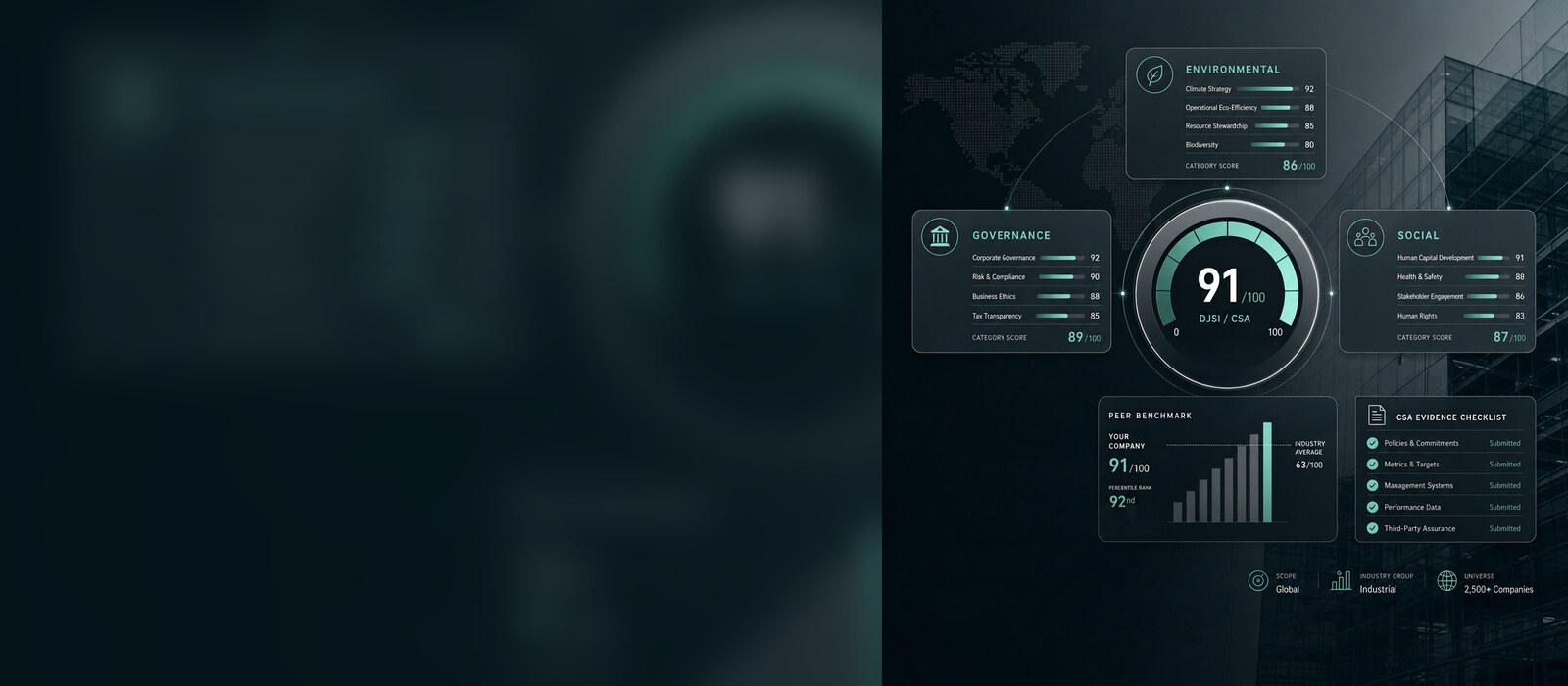
The Dow Jones Sustainability Index (DJSI) is one of the best-known benchmarks used to identify companies with strong sustainability performance. For companies aiming to improve their position, the key is understanding what is assessed, how performance is measured, and where improvements can have the greatest impact.
How Does DJSI Assessment Work?
Companies are assessed through the S&P Global Corporate Sustainability Assessment (CSA), which reviews sustainability performance across environmental, social and governance areas.
The assessment is industry-specific, meaning companies are evaluated against the sustainability issues most relevant to their sector and benchmarked against their peers.
There is no universal DJSI pass score. Performance is relative, and stronger-performing companies may become eligible for inclusion in the relevant Dow Jones sustainability indices.
What Are the Main DJSI Assessment Criteria?
The exact criteria vary by industry, but typically cover three broad areas.
| Assessment area | Typical criteria |
|---|---|
| Governance and economic | Corporate governance; Business ethics and compliance; Risk management; Supply chain management; Cybersecurity and data protection; Tax strategy; Innovation |
| Environmental | Climate strategy; Greenhouse gas emissions; Energy use; Water management; Waste and circularity; Biodiversity; Environmental targets and performance |
| Social | Human rights; Labour practices; Health and safety; Talent development; Diversity and inclusion; Employee engagement; Supply chain labour standards |
The weighting of each area depends on the company’s sector.
How Is DJSI Performance Scored?
Companies receive a sustainability score based on their responses, supporting evidence and disclosed performance.
The assessment looks beyond whether a company has ESG policies in place. It also considers whether those policies are supported by clear responsibilities, measurable targets, implementation processes, monitoring and reporting, quantitative performance data, and public disclosure.
This means a company may already have strong sustainability initiatives but still underperform if these are not properly documented or communicated through its ESG disclosures.
What Commonly Affects DJSI Performance?
- •Weak documentation — policies or processes may exist but are not formally documented.
- •Limited disclosure — good ESG performance may not be clearly reported in sustainability reports, annual reports or company policies.
- •Incomplete data — information can be fragmented across departments or locations.
- •Lack of ownership — responses may require input from HR, procurement, finance, legal, operations and sustainability teams.
- •Industry-specific gaps — companies may focus on broad ESG issues while overlooking criteria that carry greater weight within their sector.
How Can Companies Improve Their DJSI Performance?
The strongest starting point is a structured gap assessment against the relevant industry criteria.
- •Missing policies or documentation
- •Weak supporting evidence
- •ESG data gaps
- •Areas of limited disclosure
- •Opportunities for quick improvements
- •Longer-term sustainability priorities
Companies should then prioritise the highest-impact criteria, strengthen supporting evidence, improve ESG disclosures and ensure responsibilities are clearly assigned internally. Accurate GHG data and robust internal systems can provide an important foundation for this work.
Importantly, DJSI performance should not be treated purely as a reporting exercise. Strong scores ultimately depend on credible sustainability systems, measurable performance and transparent reporting.
How The Carbon Collective Company Can Support
The Carbon Collective Company supports organisations preparing for DJSI and the S&P Global CSA through ESG performance improvement programmes designed around their industry and priorities.
- •Readiness and gap assessments
- •Industry-specific criteria reviews
- •ESG documentation and evidence reviews
- •Data and disclosure gap identification
- •Questionnaire and submission support
- •Post-assessment improvement planning
Our focus is to help companies identify where improvements can be made, strengthen the quality of their submission and build a clearer roadmap for long-term sustainability performance.